
EV Charger Statistics (Roaring Fork Valley, CO, 2026): Adoption, Costs, Cold-Weather Data & Rebates
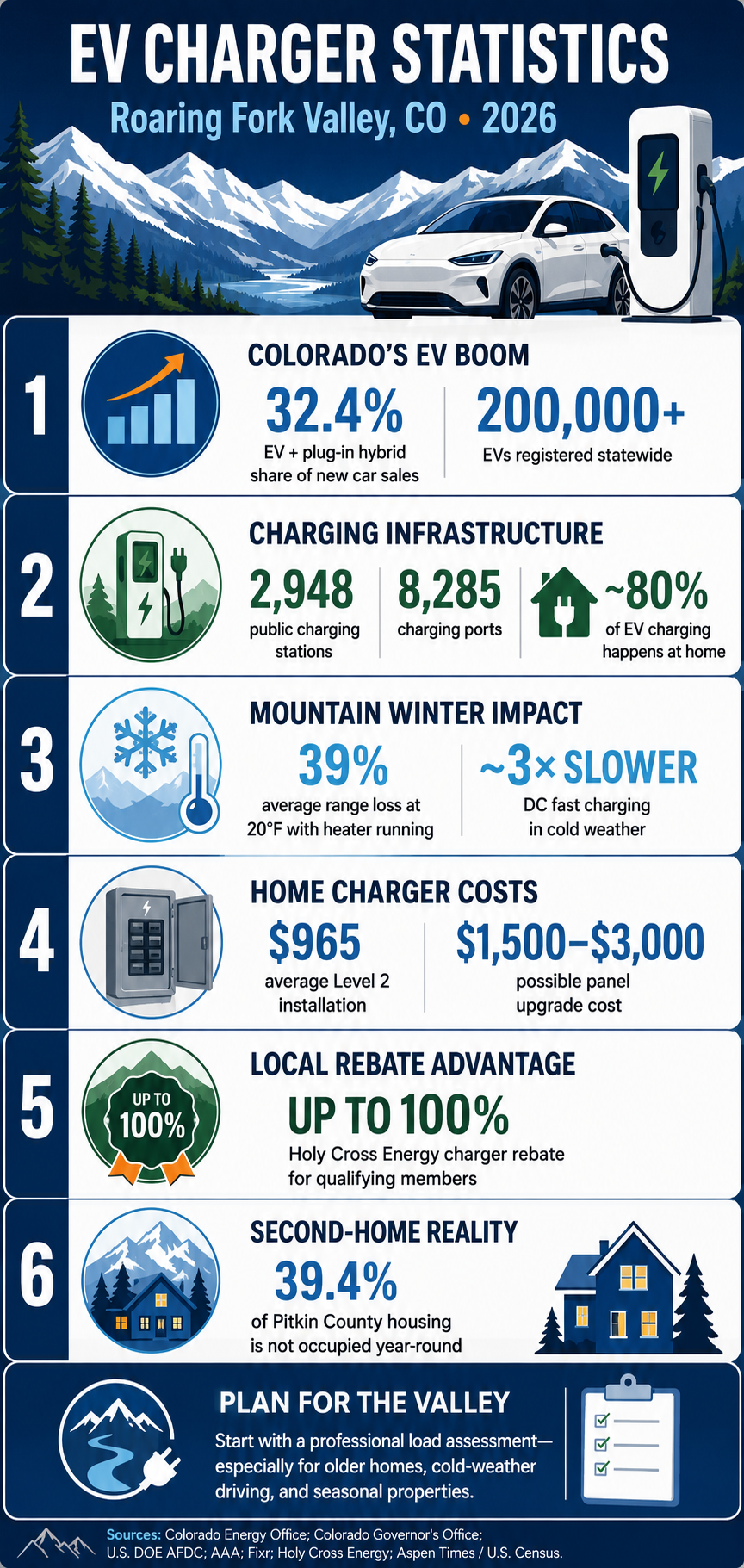
Colorado now leads the nation in EV adoption, with electric vehicles and plug-in hybrids making up a record 32.4% of new car sales in a single quarter (Colorado Energy Office, 2025) and nowhere does that growth collide with reality quite like the Roaring Fork Valley, where sub-zero mornings, 8,000-foot elevations, and a housing stock split between full-time residences and seasonal second homes all shape how, when, and where people actually charge.
For homeowners in Rifle, Aspen, Glenwood Springs, Basalt, and the surrounding valley, understanding the real numbers behind EV ownership, from EV charger installation costs to how much range disappears in a mountain winter, makes the difference between a smooth charging setup and a frustrating one.
| Quick Fact | Figure | Source |
|---|---|---|
| Colorado’s EV + PHEV market share, Q3 2025 | 32.4% of new car sales | Colorado Energy Office (2025) |
| Colorado EVs currently registered statewide | 200,000+ | Colorado Governor’s Office (2025) |
| Public EV charging stations in Colorado | 2,948 stations / 8,285 ports | U.S. DOE AFDC (2026) |
| Share of all EV charging done at home nationally | ~80% | U.S. Dept. of Energy (2026) |
| EV range lost at 20°F with heater running | 39% | AAA (2026) |
| Pitkin County housing units NOT occupied year-round | 39.4% | Aspen Times / 2020 Census (2023) |
| Avg. national Level 2 home charger install cost | $965 | Fixr.com (2025) |
| Holy Cross Energy’s Charge at Home charger rebate | Up to 100% of charger cost | ChargePoint / Holy Cross Energy |
Colorado’s EV Boom, By the Numbers
- Colorado and California led the country in EV registration share in Q3 2025, at 29.4% and 31.5% respectively, of all new vehicle registrations (Alliance for Automotive Innovation Get Connected Report, 2025).
- Statewide EV registrations more than quadrupled between 2019 and 2023, climbing from 19,200 to 90,100 vehicles (U.S. DOE Alternative Fuels Data Center, 2025).
- Colorado’s EV and plug-in hybrid combined market share hit a single-quarter national record of 32.4% in Q3 2025, driven partly by buyers rushing to use expiring federal tax credits (Colorado Energy Office, 2025).
- The state has now surpassed 200,000 total EV registrations, per the Governor’s Office (2025).
- New EV registrations fell sharply — down 64% — in the first quarter of 2026 after the federal tax credit expired and Colorado’s own credit was reduced, a reminder that incentive timing still drives a large share of purchase decisions (Colorado Sun, 2026).
Statewide adoption numbers describe a market. What they don’t describe is a mountain town where a large share of the vehicle fleet only shows up seasonally — which is exactly the case in the Roaring Fork Valley, where the housing stock itself skews toward second homes far more than most of Colorado’s Front Range.
Charging Infrastructure: Built for a Statewide Network, Not Always for Mountain Towns
- As of 2026, Colorado has 2,948 public EV charging stations with 8,285 total charging ports — 6,606 Level 2 ports and 1,592 DC fast-charging ports — putting it 7th nationally for total charging infrastructure (U.S. DOE Alternative Fuels Data Center, 2026).
- At the start of 2025, Colorado had 436 high-speed (DC fast) charging stations with 1,141 ports statewide, and the majority of that infrastructure was concentrated in the Denver metro area (Joint Office of Energy and Transportation, 2025).
- Colorado has already awarded nearly $25.6 million in federal NEVI funding to support 246 fast-charging ports along major state corridors, with the final $12 million of its $56.5 million allocation recently approved (Colorado Governor’s Office, 2025).
- Nationally, about 80% of all EV charging still happens at home rather than at public stations, according to the U.S. Department of Energy — a figure that matters even more in a valley where public fast-chargers thin out quickly once you leave the highway corridor (U.S. Department of Energy, 2026; Argonne National Laboratory, 2026).
Public charging investment nationally and statewide is real, but it’s built around interstate corridors and metro density. For homes tucked into side canyons or up-valley from Aspen, a dependable public charger simply isn’t always close by — which is exactly why home charging capacity matters more here than in a Denver suburb.
Cold Weather, Elevation & the Mountain EV Charging Penalty
- AAA’s 2026 cold-weather study found EVs lose an average of 39% of their driving range and suffer a 35.6% drop in efficiency at 20°F — a temperature the Roaring Fork Valley regularly sees for weeks at a time each winter (AAA Newsroom, 2026).
- Winter cold raises EV operating costs by $32.11 per 1,000 miles when charging at home, and by as much as $76.93 per 1,000 miles for drivers relying on public charging (AAA Newsroom, 2026).
- A separate large-scale study of more than 30,000 real-world EVs found an average 22% range loss at freezing (32°F), with the worst-performing models (those without heat pumps) retaining as little as 63% of rated range (Recurrent, 2026).
- Cold temperatures can slow DC fast-charging speeds by nearly three times, according to Idaho National Laboratory research — meaning a “quick” public charge in January can take substantially longer than the same stop in July (Idaho National Laboratory, cited 2026).
The national conversation about cold-weather range loss is written with a 20°F test day in mind. In Aspen and Glenwood Springs, that’s a mild morning, not a worst case. Homeowners here should plan charging capacity and overnight charge windows around genuinely cold, high-elevation conditions — not the more forgiving averages used in national coverage.
EV Home Charger Costs and Why Older Mountain Homes Pay More
- The national average cost for a professionally installed Level 2 home EV charging station is $965, with a typical range of $551 to $1,383 (Fixr.com, 2025).
- Broader industry data puts typical nationwide Level 2 installs between $800 and $2,500 once hardware, labor, and permitting are all included (EV Charging industry pricing guide, 2025).
- Panel upgrades alone can add $1,500 to $3,000 to a project — a cost driver disproportionately common in homes built before the 1990s, a large share of the valley’s original housing stock (Recharged.com, 2025).
- The federal tax credit for home EV charger equipment currently covers 30% of cost, up to $1,000, for eligible homeowners (Argonne National Laboratory, 2026).
- The average U.S. residential electricity rate is roughly $0.17 per kWh, though Colorado mountain-town rates and utility programs can shift the real cost of home charging up or down from that baseline (Choose Energy / ComparePower, 2025).
A cost estimate built around a newer suburban home with an underused panel doesn’t hold up in a valley full of 1960s–1980s cabins already carrying heat pumps, hot tubs, and snowmelt systems. For many Roaring Fork Valley homes, the panel — not the charger — is the real cost driver, which is exactly why a load assessment should come before any charger purchase.
Holy Cross Energy: The Local Utility Angle for Roaring Fork Valley EV Charger Rebates
- Holy Cross Energy, the member-owned utility serving the Roaring Fork Valley, offers a Charge at Home program that has fully rebated Level 2 home chargers at up to 100% of cost for qualifying members (ChargePoint / Holy Cross Energy case study).
- HCE has grown from 175 founding member-families in 1939 to roughly 43,000 members today across the Roaring Fork, Crystal River, Colorado River, and Vail/Eagle River valleys (ChargePoint / Holy Cross Energy case study).
- The utility has set a goal of reaching 70% renewable energy by 2030, up from 44% in 2019 (ChargePoint / Holy Cross Energy case study).
- Combined residential efficiency and electrification rebates through HCE are capped at 25% of project cost, up to $5,000 per account per year — on top of any charger-specific rebate (Love Electric, 2024).
This is the single biggest advantage Roaring Fork Valley homeowners have: a not-for-profit local utility actively subsidizing home chargers, rather than a distant investor-owned utility with no local rebate program at all.
Not sure if your home qualifies for a charger rebate? Always On Electric, Inc. can help you navigate Holy Cross Energy’s programs.
Second Homes, Vacant Housing & What It Means for EV Charger Demand in Roaring Fork Valley
- In Pitkin County, only 60.6% of housing units were occupied year-round as of the 2020 Census, meaning nearly 4 in 10 homes sit vacant much of the year or function as second homes and vacation rentals (Aspen Times reporting on 2020 Census data, 2023).
- By contrast, Garfield County — home to Glenwood Springs and much of the down-valley workforce housing — had a 92.8% occupancy rate over the same period, illustrating how differently charger demand behaves upvalley versus downvalley (Aspen Times reporting on 2020 Census data, 2023).
- Pitkin County’s population grew just 1.2% between 2010 and 2020, the slowest of the three-county region, while its second-home and short-term rental market has continued to expand (Aspen Times reporting on 2020 Census data, 2023).
A charger installed at a full-time Glenwood Springs residence gets used daily. A charger installed at an Aspen second home may sit unused for months, then face a sudden full-household load during ski season — a very different design problem that a generic national install guide never accounts for.
Summary Table
| Statistic | Figure | Source | Year |
|---|---|---|---|
| Colorado EV registration share of new sales (Q3) | 29.4% | Alliance for Automotive Innovation | 2025 |
| Colorado + California top states for EV registration share | CA 31.5% / CO 29.4% | Alliance for Automotive Innovation | 2025 |
| Colorado EVs registered, 2019 vs. 2023 | 19,200 → 90,100 | U.S. DOE AFDC | 2025 |
| Colorado EV + PHEV market share (single quarter record) | 32.4% | Colorado Energy Office | 2025 |
| Total Colorado EV registrations | 200,000+ | Colorado Governor’s Office | 2025 |
| Colorado new EV registration decline, Q1 2026 | -64% | Colorado Sun | 2026 |
| Colorado public EV charging stations | 2,948 | U.S. DOE AFDC | 2026 |
| Colorado public EV charging ports | 8,285 (6,606 L2 / 1,592 DCFC) | U.S. DOE AFDC | 2026 |
| Colorado’s national charging-infrastructure rank | 7th (3.4% of U.S. network) | U.S. DOE AFDC | 2026 |
| Colorado DC fast-charging stations, early 2025 | 436 stations / 1,141 ports | Joint Office of Energy & Transportation | 2025 |
| Colorado NEVI fast-charging ports funded | 246 ports / $25.6M awarded | Colorado Governor’s Office | 2025 |
| Share of U.S. EV charging done at home | ~80% | U.S. Dept. of Energy / Argonne Nat’l Lab | 2026 |
| EV range loss at 20°F with heater on | 39% | AAA | 2026 |
| EV efficiency (MPGe) drop at 20°F | 35.6% | AAA | 2026 |
| Winter cost increase, home charging | +$32.11 / 1,000 mi | AAA | 2026 |
| Winter cost increase, public charging | +$76.93 / 1,000 mi | AAA | 2026 |
| Average range loss at freezing (32°F), 30,000+ EVs | 22% | Recurrent | 2026 |
| Worst-case winter range retention (no heat pump) | 63% | Recurrent | 2026 |
| DC fast-charging slowdown in cold weather | ~3x slower | Idaho National Laboratory | 2026 |
| National avg. Level 2 home charger install cost | $965 ($551–$1,383 range) | Fixr.com | 2025 |
| Typical nationwide Level 2 install cost range | $800–$2,500 | EV Charging industry guide | 2025 |
| Added cost for panel upgrades | $1,500–$3,000 | Recharged.com | 2025 |
| Federal home charger tax credit | 30% up to $1,000 | Argonne National Laboratory | 2026 |
| Avg. U.S. residential electricity rate | ~$0.17/kWh | Choose Energy / ComparePower | 2025 |
| Holy Cross Energy Charge at Home charger rebate | Up to 100% of cost | ChargePoint / Holy Cross Energy | — |
| Holy Cross Energy membership, 1939 vs. today | 175 families → ~43,000 members | ChargePoint / Holy Cross Energy | — |
| Holy Cross Energy renewable energy goal | 70% by 2030 (from 44% in 2019) | ChargePoint / Holy Cross Energy | — |
| HCE combined efficiency/electrification rebate cap | 25% of cost, up to $5,000/yr | Love Electric | 2024 |
| Pitkin County housing occupied year-round | 60.6% | Aspen Times / 2020 Census | 2023 |
| Garfield County housing occupied year-round | 92.8% | Aspen Times / 2020 Census | 2023 |
| Pitkin County population growth, 2010–2020 | 1.2% | Aspen Times / 2020 Census | 2023 |
Frequently Asked Questions
What is the average cost to install a home EV charger in the Roaring Fork Valley?
Nationally, a Level 2 home charger install averages around $965, with most projects falling between $551 and $1,383 (Fixr.com, 2025). In older Roaring Fork Valley homes, a panel upgrade often adds $1,500 to $3,000 on top of that (Recharged.com, 2025) — though Holy Cross Energy’s Charge at Home program can offset or fully rebate the charger cost itself.
How much EV range is lost in cold mountain weather?
AAA’s 2026 testing found EVs lose an average of 39% of driving range at 20°F, a temperature common across valley winters, along with a 35.6% drop in overall efficiency (AAA, 2026).
Does Holy Cross Energy offer rebates for EV chargers?
Yes. Holy Cross Energy’s Charge at Home program has fully rebated Level 2 home chargers for qualifying members at up to 100% of cost, in addition to broader efficiency and electrification rebates capped at 25% of project cost per year (ChargePoint / Holy Cross Energy; Love Electric, 2024).
How many public EV charging stations are there in Colorado?
Colorado has 2,948 public EV charging stations and 8,285 charging ports as of 2026, ranking it 7th nationally for charging infrastructure (U.S. DOE Alternative Fuels Data Center, 2026).
Is Colorado a leading state for EV adoption?
Yes. Colorado posted a record 32.4% combined EV and plug-in hybrid market share in a single quarter in 2025 and has surpassed 200,000 total EV registrations statewide (Colorado Energy Office; Colorado Governor’s Office, 2025).
Methodology & Sources
This report was compiled by the Always On Electric Inc. team using publicly available data from government agencies, utility program documentation, and independent automotive research organizations. Every statistic is attributed to its original source and year; no figures were estimated or fabricated.
- U.S. Department of Energy, Alternative Fuels Data Center (AFDC) — federal data on EV registrations and public charging infrastructure by state
- Colorado Energy Office / Colorado Governor’s Office — state EV adoption figures, tax credit and rebate program details
- Colorado Auto Dealers Association (via Colorado Sun reporting) — quarterly new vehicle and EV registration data
- Alliance for Automotive Innovation — state-by-state EV registration and market share analysis
- AAA — controlled cold- and hot-weather EV range and efficiency testing
- Recurrent — real-world winter range-loss data across 30,000+ vehicles
- Idaho National Laboratory — cold-weather DC fast-charging speed research
- Fixr.com / Recharged.com / EV Charging industry pricing guides — home charger installation cost benchmarking
- Argonne National Laboratory — home charging behavior and federal tax credit details
- ChargePoint (Holy Cross Energy case study) / Love Electric — Holy Cross Energy’s Charge at Home program and residential rebate structure
- Aspen Times (reporting on 2020 U.S. Census data) — Pitkin and Garfield County housing occupancy figures
Ready to add EV charging to your Roaring Fork Valley home or business? Always On Electric Inc. provides EV charger installation in Roaring Fork Valley across Aspen, Glenwood Springs, Basalt, and the surrounding valley — including load assessments for older homes and guidance on Holy Cross Energy rebates. Reach out today to get your charging project started.
