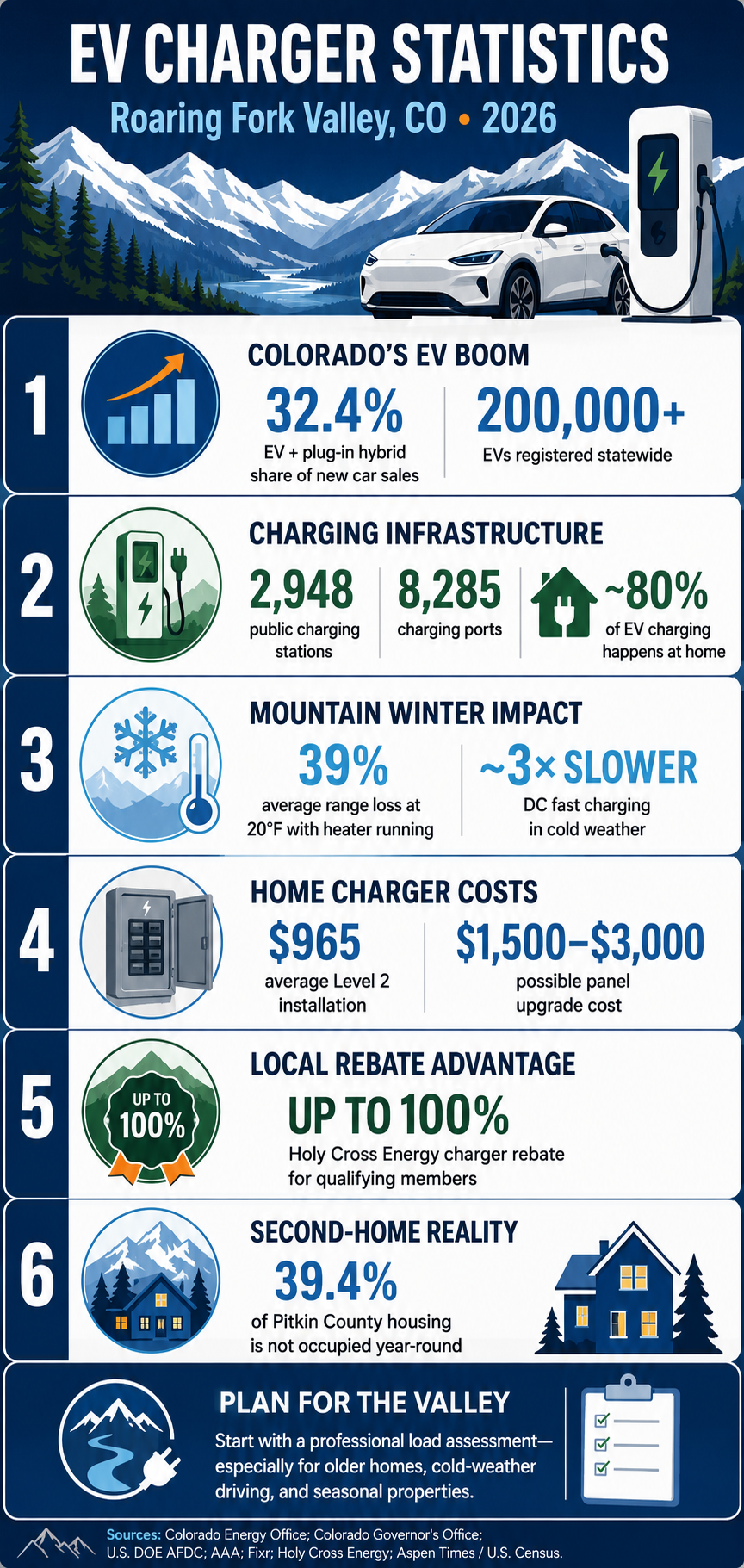
Colorado now leads the nation in EV adoption, with electric vehicles and plug-in hybrids making up a record 32.4% of new car sales in a single quarter (Colorado Energy Office, 2025) and nowhere does that growth collide with reality quite like the Roaring Fork Valley, where sub-zero mornings, 8,000-foot elevations, and a housing stock split between full-time residences and seasonal second homes all shape how, when, and where people actually charge.
For homeowners in Rifle, Aspen, Glenwood Springs, Basalt, and the surrounding valley, understanding the real numbers behind EV ownership, from EV charger installation costs to how much range disappears in a mountain winter, makes the difference between a smooth charging setup and a frustrating one.
Quick Fact
Figure
Source
Colorado’s EV + PHEV market share, Q3 2025
32.4% of new car sales
Colorado Energy Office (2025)
Colorado EVs currently registered statewide
200,000+
Colorado Governor’s Office (2025)
Public EV charging stations in Colorado
2,948 stations / 8,285 ports
U.S. DOE AFDC (2026)
Share of all EV charging done at home nationally
~80%
U.S. Dept. of Energy (2026)
EV range lost at 20°F with heater running
39%
AAA (2026)
Pitkin County housing units NOT occupied year-round
39.4%
Aspen Times / 2020 Census (2023)
Avg. national Level 2 home charger install cost
$965
Fixr.com (2025)
Holy Cross Energy’s Charge at Home charger rebate
Up to 100% of charger cost
ChargePoint / Holy Cross Energy
Colorado’s EV Boom, By the Numbers
Colorado and California led the country in EV registration share in Q3 2025, at 29.4% and 31.5% respectively, of all new vehicle registrations (Alliance for Automotive Innovation Get Connected Report, 2025).
Statewide EV registrations more than quadrupled between 2019 and 2023, climbing from 19,200 to 90,100 vehicles (U.S. DOE Alternative Fuels Data Center, 2025).
Colorado’s EV and plug-in hybrid combined market share hit a single-quarter national record of 32.4% in Q3 2025, driven partly by buyers rushing to use expiring federal tax credits (Colorado Energy Office, 2025).
The state has now surpassed 200,000 total EV registrations, per the Governor’s Office (2025).
New EV registrations fell sharply — down 64% — in the first quarter of 2026 after the federal tax credit expired and Colorado’s own credit was reduced, a reminder that incentive timing still drives a large share of purchase decisions (Colorado Sun, 2026).
Statewide adoption numbers describe a market. What they don’t describe is a mountain town where a large share of the vehicle fleet only shows up seasonally — which is exactly the case in the Roaring Fork Valley, where the housing stock itself skews toward second homes far more than most of Colorado’s Front Range.
Charging Infrastructure: Built for a Statewide Network, Not Always for Mountain Towns
As of 2026, Colorado has 2,948 public EV charging stations with 8,285 total charging ports — 6,606 Level 2 ports and 1,592 DC fast-charging ports — putting it 7th nationally for total charging infrastructure (U.S. DOE Alternative Fuels Data Center, 2026).
At the start of 2025, Colorado had 436 high-speed (DC fast) charging stations with 1,141 ports statewide, and the majority of that infrastructure was concentrated in the Denver metro area (Joint Office of Energy and Transportation, 2025).
Colorado has already awarded nearly $25.6 million in federal NEVI funding to support 246 fast-charging ports along major state corridors, with the final $12 million of its $56.5 million allocation recently approved (Colorado Governor’s Office, 2025).
Nationally, about 80% of all EV charging still happens at home rather than at public stations, according to the U.S. Department of Energy — a figure that matters even more in a valley where public fast-chargers thin out quickly once you leave the highway corridor (U.S. Department of Energy, 2026; Argonne National Laboratory, 2026).
Public charging investment nationally and statewide is real, but it’s built around interstate corridors and metro density. For homes tucked into side canyons or up-valley from Aspen, a dependable public charger simply isn’t always close by — which is exactly why home charging capacity matters more here than in a Denver suburb.
Cold Weather, Elevation & the Mountain EV Charging Penalty
AAA’s 2026 cold-weather study found EVs lose an average of 39% of their driving range and suffer a 35.6% drop in efficiency at 20°F — a temperature the Roaring Fork Valley regularly sees for weeks at a time each winter (AAA Newsroom, 2026).
Winter cold raises EV operating costs by $32.11 per 1,000 miles when charging at home, and by as much as $76.93 per 1,000 miles for drivers relying on public charging (AAA Newsroom, 2026).
A separate large-scale study of more than 30,000 real-world EVs found an average 22% range loss at freezing (32°F), with the worst-performing models (those without heat pumps) retaining as little as 63% of rated range (Recurrent, 2026).
Cold temperatures can slow DC fast-charging speeds by nearly three times, according to Idaho National Laboratory research — meaning a “quick” public charge in January can take substantially longer than the same stop in July (Idaho National Laboratory, cited 2026).
The national conversation about cold-weather range loss is written with a 20°F test day in mind. In Aspen and Glenwood Springs, that’s a mild morning, not a worst case. Homeowners here should plan charging capacity and overnight charge windows around genuinely cold, high-elevation conditions — not the more forgiving averages used in national coverage.
EV Home Charger Costs and Why Older Mountain Homes Pay More
The national average cost for a professionally installed Level 2 home EV charging station is $965, with a typical range of $551 to $1,383 (Fixr.com, 2025).
Broader industry data puts typical nationwide Level 2 installs between $800 and $2,500 once hardware, labor, and permitting are all included (EV Charging industry pricing guide, 2025).
Panel upgrades alone can add $1,500 to $3,000 to a project — a cost driver disproportionately common in homes built before the 1990s, a large share of the valley’s original housing stock (Recharged.com, 2025).
The federal tax credit for home EV charger equipment currently covers 30% of cost, up to $1,000, for eligible homeowners (Argonne National Laboratory, 2026).
The average U.S. residential electricity rate is roughly $0.17 per kWh, though Colorado mountain-town rates and utility programs can shift the real cost of home charging up or down from that baseline (Choose Energy / ComparePower, 2025).
A cost estimate built around a newer suburban home with an underused panel doesn’t hold up in a valley full of 1960s–1980s cabins already carrying heat pumps, hot tubs, and snowmelt systems. For many Roaring Fork Valley homes, the panel — not the charger — is the real cost driver, which is exactly why a load assessment should come before any charger purchase.
Holy Cross Energy: The Local Utility Angle for Roaring Fork Valley EV Charger Rebates
Holy Cross Energy, the member-owned utility serving the Roaring Fork Valley, offers a Charge at Home program that has fully rebated Level 2 home chargers at up to 100% of cost for qualifying members (ChargePoint / Holy Cross Energy case study).
HCE has grown from 175 founding member-families in 1939 to roughly 43,000 members today across the Roaring Fork, Crystal River, Colorado River, and Vail/Eagle River valleys (ChargePoint / Holy Cross Energy case study).
The utility has set a goal of reaching 70% renewable energy by 2030, up from 44% in 2019 (ChargePoint / Holy Cross Energy case study).
Combined residential efficiency and electrification rebates through HCE are capped at 25% of project cost, up to $5,000 per account per year — on top of any charger-specific rebate (Love Electric, 2024).
This is the single biggest advantage Roaring Fork Valley homeowners have: a not-for-profit local utility actively subsidizing home chargers, rather than a distant investor-owned utility with no local rebate program at all.
Not sure if your home qualifies for a charger rebate? Always On Electric, Inc. can help you navigate Holy Cross Energy’s programs.
Second Homes, Vacant Housing & What It Means for EV Charger Demand in Roaring Fork Valley
In Pitkin County, only 60.6% of housing units were occupied year-round as of the 2020 Census, meaning nearly 4 in 10 homes sit vacant much of the year or function as second homes and vacation rentals (Aspen Times reporting on 2020 Census data, 2023).
By contrast, Garfield County — home to Glenwood Springs and much of the down-valley workforce housing — had a 92.8% occupancy rate over the same period, illustrating how differently charger demand behaves upvalley versus downvalley (Aspen Times reporting on 2020 Census data, 2023).
Pitkin County’s population grew just 1.2% between 2010 and 2020, the slowest of the three-county region, while its second-home and short-term rental market has continued to expand (Aspen Times reporting on 2020 Census data, 2023).
A charger installed at a full-time Glenwood Springs residence gets used daily. A charger installed at an Aspen second home may sit unused for months, then face a sudden full-household load during ski season — a very different design problem that a generic national install guide never accounts for.
Summary Table
Statistic
Figure
Source
Year
Colorado EV registration share of new sales (Q3)
29.4%
Alliance for Automotive Innovation
2025
Colorado + California top states for EV registration share
CA 31.5% / CO 29.4%
Alliance for Automotive Innovation
2025
Colorado EVs registered, 2019 vs. 2023
19,200 → 90,100
U.S. DOE AFDC
2025
Colorado EV + PHEV market share (single quarter record)
32.4%
Colorado Energy Office
2025
Total Colorado EV registrations
200,000+
Colorado Governor’s Office
2025
Colorado new EV registration decline, Q1 2026
-64%
Colorado Sun
2026
Colorado public EV charging stations
2,948
U.S. DOE AFDC
2026
Colorado public EV charging ports
8,285 (6,606 L2 / 1,592 DCFC)
U.S. DOE AFDC
2026
Colorado’s national charging-infrastructure rank
7th (3.4% of U.S. network)
U.S. DOE AFDC
2026
Colorado DC fast-charging stations, early 2025
436 stations / 1,141 ports
Joint Office of Energy & Transportation
2025
Colorado NEVI fast-charging ports funded
246 ports / $25.6M awarded
Colorado Governor’s Office
2025
Share of U.S. EV charging done at home
~80%
U.S. Dept. of Energy / Argonne Nat’l Lab
2026
EV range loss at 20°F with heater on
39%
AAA
2026
EV efficiency (MPGe) drop at 20°F
35.6%
AAA
2026
Winter cost increase, home charging
+$32.11 / 1,000 mi
AAA
2026
Winter cost increase, public charging
+$76.93 / 1,000 mi
AAA
2026
Average range loss at freezing (32°F), 30,000+ EVs
22%
Recurrent
2026
Worst-case winter range retention (no heat pump)
63%
Recurrent
2026
DC fast-charging slowdown in cold weather
~3x slower
Idaho National Laboratory
2026
National avg. Level 2 home charger install cost
$965 ($551–$1,383 range)
Fixr.com
2025
Typical nationwide Level 2 install cost range
$800–$2,500
EV Charging industry guide
2025
Added cost for panel upgrades
$1,500–$3,000
Recharged.com
2025
Federal home charger tax credit
30% up to $1,000
Argonne National Laboratory
2026
Avg. U.S. residential electricity rate
~$0.17/kWh
Choose Energy / ComparePower
2025
Holy Cross Energy Charge at Home charger rebate
Up to 100% of cost
ChargePoint / Holy Cross Energy
—
Holy Cross Energy membership, 1939 vs. today
175 families → ~43,000 members
ChargePoint / Holy Cross Energy
—
Holy Cross Energy renewable energy goal
70% by 2030 (from 44% in 2019)
ChargePoint / Holy Cross Energy
—
HCE combined efficiency/electrification rebate cap
25% of cost, up to $5,000/yr
Love Electric
2024
Pitkin County housing occupied year-round
60.6%
Aspen Times / 2020 Census
2023
Garfield County housing occupied year-round
92.8%
Aspen Times / 2020 Census
2023
Pitkin County population growth, 2010–2020
1.2%
Aspen Times / 2020 Census
2023
Frequently Asked Questions
What is the average cost to install a home EV charger in the Roaring Fork Valley?
Nationally, a Level 2 home charger install averages around $965, with most projects falling between $551 and $1,383 (Fixr.com, 2025). In older Roaring Fork Valley homes, a panel upgrade often adds $1,500 to $3,000 on top of that (Recharged.com, 2025) — though Holy Cross Energy’s Charge at Home program can offset or fully rebate the charger cost itself.
How much EV range is lost in cold mountain weather?
AAA’s 2026 testing found EVs lose an average of 39% of driving range at 20°F, a temperature common across valley winters, along with a 35.6% drop in overall efficiency (AAA, 2026).
Does Holy Cross Energy offer rebates for EV chargers?
Yes. Holy Cross Energy’s Charge at Home program has fully rebated Level 2 home chargers for qualifying members at up to 100% of cost, in addition to broader efficiency and electrification rebates capped at 25% of project cost per year (ChargePoint / Holy Cross Energy; Love Electric, 2024).
How many public EV charging stations are there in Colorado?
Colorado has 2,948 public EV charging stations and 8,285 charging ports as of 2026, ranking it 7th nationally for charging infrastructure (U.S. DOE Alternative Fuels Data Center, 2026).
Is Colorado a leading state for EV adoption?
Yes. Colorado posted a record 32.4% combined EV and plug-in hybrid market share in a single quarter in 2025 and has surpassed 200,000 total EV registrations statewide (Colorado Energy Office; Colorado Governor’s Office, 2025).
Methodology & Sources
This report was compiled by the Always On Electric Inc. team using publicly available data from government agencies, utility program documentation, and independent automotive research organizations. Every statistic is attributed to its original source and year; no figures were estimated or fabricated.
U.S. Department of Energy, Alternative Fuels Data Center (AFDC) — federal data on EV registrations and public charging infrastructure by state
Colorado Energy Office / Colorado Governor’s Office — state EV adoption figures, tax credit and rebate program details
Colorado Auto Dealers Association (via Colorado Sun reporting) — quarterly new vehicle and EV registration data
Alliance for Automotive Innovation — state-by-state EV registration and market share analysis
AAA — controlled cold- and hot-weather EV range and efficiency testing
Recurrent — real-world winter range-loss data across 30,000+ vehicles
Idaho National Laboratory — cold-weather DC fast-charging speed research
Fixr.com / Recharged.com / EV Charging industry pricing guides — home charger installation cost benchmarking
Argonne National Laboratory — home charging behavior and federal tax credit details
ChargePoint (Holy Cross Energy case study) / Love Electric — Holy Cross Energy’s Charge at Home program and residential rebate structure
Aspen Times (reporting on 2020 U.S. Census data) — Pitkin and Garfield County housing occupancy figures
Ready to add EV charging to your Roaring Fork Valley home or business? Always On Electric Inc. provides EV charger installation in Roaring Fork Valley across Aspen, Glenwood Springs, Basalt, and the surrounding valley — including load assessments for older homes and guidance on Holy Cross Energy rebates. Reach out today to get your charging project started.
From the high-altitude weather swings to the mix of older mountain cabins and newer luxury builds, the electrical demands on homes in the Roaring Fork Valley, CO region can be significant. Whether you live in Glenwood Springs, CO, or up valley in Aspen, CO, understanding the most common electrical problems can help you protect your home, your family, and your investment.
Knowing when to handle something yourself and when to call a licensed electrician is one of the smartest things a homeowner in Colorado can do.
1. Flickering or Dimming Lights
Flickering lights are one of the most frequently reported electrical issues in homes throughout the Roaring Fork Valley. While a single flickering bulb is usually just a loose connection or a bulb nearing the end of its life, widespread flickering across multiple rooms is a different story. This pattern often points to a more serious underlying issue, such as a loose service connection, a failing breaker, or overloaded circuits.
In older homes, particularly those built in the 1960s and 1970s that are common in parts of Glenwood Springs, CO, and the surrounding communities, outdated wiring can struggle to keep up with modern electrical loads. Homes that were originally designed for far fewer appliances and devices often develop flickering issues as the demand on the system increases over the years.
If the flickering is persistent, happens during high-usage periods, or is accompanied by a buzzing sound from your panel or outlets, do not ignore it. This is a situation where electrical troubleshooting by a licensed electrician is essential. A professional can identify whether the problem lies in a single circuit, the main panel, or the service connection coming into the home.
2. Tripping Circuit Breakers
A circuit breaker that trips occasionally is doing exactly what it is designed to do: protecting your home from an overload. But when breakers trip repeatedly, or when the same circuit keeps tripping without an obvious cause, it is a sign that something more significant is going on.
Common causes include overloaded circuits, short circuits, and ground faults. In the Roaring Fork Valley, CO, where homes are often used as vacation properties or short-term rentals, the electrical load on a home can fluctuate dramatically. A home that sits empty for months and then hosts a full household for ski season can put sudden stress on circuits that were barely managing before.
Home electrical repair for a tripping breaker is not always a simple fix. In some cases, the solution is as straightforward as redistributing loads across circuits. In others, it requires adding new circuits or upgrading the panel entirely. A residential electrician can run a full assessment of your load distribution and determine the safest and most cost-effective solution for your specific home.
3. Outdated or Undersized Electrical Panels
This is one of the most significant electrical concerns for homeowners in older parts of the valley, including many neighborhoods in Glenwood Springs, CO, and some of the original residential areas of Aspen, CO. Many homes built before the 1990s were equipped with panels that simply were not designed to handle today’s electrical demands.
An electrical panel upgrade is often one of the best investments a Colorado homeowner can make. If your home still has a 100-amp service panel and you are running electric appliances, EV chargers, home offices, and smart home systems, your panel may be working far beyond its intended capacity. Warning signs include breakers that feel warm to the touch, a burning smell near the panel, breakers that no longer hold their position, or fuses that blow frequently in older fuse-box systems.
Federal Pacific and Zinsco panels, which were common in homes built from the 1950s through the 1980s, have been widely flagged by electricians and safety organizations as potential fire hazards. If your home has one of these panels, scheduling an inspection with a licensed electrician in the Roaring Fork Valley should be a priority, not an afterthought.
Modern homes often require 200-amp or even 400-amp service, especially if you are planning any kind of addition, upgrade, or electrification project. A qualified electrician can assess your current panel, walk you through your options, and handle the upgrade from start to finish, including coordinating with your local utility.
4. Faulty or Outdated Outlets and Wiring
In the Roaring Fork Valley, CO, where the real estate market includes everything from century-old Victorian homes to brand-new mountain retreats, the range of wiring conditions is enormous. Two-prong ungrounded outlets, aluminum wiring from the 1960s and 1970s, and wiring that has been modified by non-professionals over the years are all common findings during electrical inspections.
Outlets that spark, feel warm, produce a burning smell, or fail to hold plugs securely are serious warning signs. Outlets located near water sources in kitchens and bathrooms should be GFCI-protected (Ground Fault Circuit Interrupter), and in many older homes, this protection is either missing or not functioning properly. AFCI (Arc Fault Circuit Interrupter) protection, which guards against electrical fires caused by arcing faults in wiring, is another upgrade that older homes often lack.
Electrical troubleshooting for outlet and wiring issues requires more than just swapping out an outlet cover. A residential electrician needs to trace the problem back through the circuit to identify whether the issue is isolated or part of a larger wiring problem throughout the home. This is especially important in homes where DIY wiring modifications have been made by previous owners, which is not uncommon in older mountain communities.
5. Exterior and Weather-Related Electrical Issues
Living in Colorado means dealing with heavy snow loads, ice, lightning, and dramatic temperature swings. All of these factors can take a toll on exterior electrical components, including outdoor outlets, service entrance cables, landscape lighting, hot tub wiring, and the weatherhead where the utility lines connect to your home.
Ice dams and heavy snowfall can pull on service entrance cables and create loose connections at the weatherhead. Lightning strikes, which are common during Colorado summers, can cause power surges that damage appliances, electronics, and even the electrical panel itself. Homes in Aspen, CO, and other higher-elevation communities in the Roaring Fork Valley are particularly exposed to these weather events.
Surge protectors at individual outlets offer some protection, but a whole-home surge protector installed by a licensed electrician at your panel is a much more comprehensive solution. For outdoor wiring issues, including damage to exterior outlets, landscape lighting circuits, or hot tub connections, always call a licensed electrician rather than attempting repairs yourself. Outdoor electrical work involves specific code requirements around weatherproofing, conduit, and grounding that go beyond basic home electrical repair.
Conclusion
Electrical problems are not something to put off or guess your way through. In a region like the Roaring Fork Valley, CO, where homes face unique climate challenges and a wide range of building ages, working with a knowledgeable residential electrician is the safest choice. Whether you are dealing with flickering lights, a tripping breaker, an outdated panel, or weather-damaged wiring, a licensed electrician serving Glenwood Springs, CO, Aspen, CO, and the surrounding Colorado communities can provide the expert electrical troubleshooting and home electrical repair your home needs. Do not wait for a small issue to become a serious hazard. Reach out to a licensed professional and get it handled right.
Need a Licensed Residential & Commercial Electrician Near You?
At Always On Electric Inc., we take pride in being your trusted go-to electricians for all your residential and commercial needs across western Colorado. Whether you need electrical repairs, upgrades, troubleshooting, or new installations, our experienced team is here to deliver top-quality service you can count on. From Aspen to Grand Junction, Glenwood Springs to Basalt, and everywhere in between, we’re committed to keeping your home or business powered and safe. Don’t wait until small issues become big problems — reach out to us today and let us provide the reliable, professional electrical solutions you deserve!
Electrical systems power nearly every aspect of our daily lives, from lighting and appliances to heating and security systems. Yet, despite our heavy reliance on electricity, many homeowners and business owners in the Roaring Fork Valley often overlook the importance of regular electrical inspections. Whether you live in Aspen, Carbondale, Basalt, Rifle, or Glenwood Springs, maintaining home electrical safety is essential for protecting your property, your family, and your investment. A professional electrician can provide the expertise necessary to identify hidden hazards, prevent accidents, and ensure your electrical system complies with safety codes.
In this blog, we’ll explore why electrical inspections are crucial, the risks of neglecting them, and how hiring a licensed electrician can help keep your home or business safe.
Electrical Inspections in the Roaring Fork Valley
An electrical inspection is a comprehensive evaluation of your home or business’s electrical system, designed to ensure that everything is operating safely and efficiently. For residents of the Roaring Fork Valley, where diverse weather conditions and seasonal temperature fluctuations put added strain on electrical systems, these inspections are particularly important. Whether you’re located in Aspen, Carbondale, or Basalt, an inspection by a licensed electrician can help uncover potential issues that might not be visible to the untrained eye.
Over time, electrical components can wear out, wiring can degrade, and circuit overloads can occur, especially in older homes. An inspection allows a professional to detect faulty wiring, damaged outlets, improper grounding, and other hazards before they escalate into major problems. This is especially critical for properties in areas like Rifle, Glenwood Springs, and Carbondale, where older infrastructure is more common.
Additionally, electrical codes evolve over time. By hiring an electrician for a proper inspection, you can ensure that your home meets the latest safety standards, protecting not only your family but also the value of your property. In competitive housing markets like Aspen and Basalt, having proof of a recent inspection can also make your home more appealing to potential buyers.
Common Electrical Hazards Found During Inspections
Home electrical safety in the Roaring Fork Valley involves more than just avoiding overloaded outlets or replacing a blown fuse. A thorough inspection often uncovers hidden hazards that pose serious risks if left unaddressed. Licensed electricians are trained to identify these issues and recommend the right solutions.
One of the most common problems in older homes is outdated wiring. Houses built decades ago were not designed to handle the electrical demands of modern living. Appliances, HVAC systems, and entertainment technology can easily overwhelm older systems, leading to frequent breaker trips and even potential fire hazards. An electrician can assess whether your home’s wiring can handle your energy needs or if an upgrade is necessary.
Another frequent issue is improper grounding. Without proper grounding, your electrical system is more susceptible to power surges, which can damage expensive electronics and appliances. Inspections also detect overloaded circuits, loose connections, and deteriorated components, all of which can lead to sparks, short circuits, and fires.
For residents in Rifle, CO, Glenwood Springs, and Carbondale, where weather extremes can impact electrical infrastructure, inspections are particularly important. Heavy snow, ice, and fluctuating temperatures can strain wiring and outdoor panels, making preventive maintenance essential to keeping your electrical service safe and reliable.
The Role of Licensed Electricians in Protecting Your Home
When it comes to electrical safety, hiring a licensed electrician in Aspen, Carbondale, or Basalt is non-negotiable. Attempting DIY repairs or relying on unqualified labor can lead to costly mistakes and dangerous conditions. Licensed electricians undergo extensive training, meet strict certification standards, and stay updated on local building codes, ensuring your system complies with all regulations.
A licensed electrician performs a detailed electrical inspection using specialized tools and techniques to detect issues that homeowners might overlook. Beyond checking wiring and outlets, they assess your circuit breakers, grounding systems, surge protection, and the overall capacity of your electrical panel. In areas like Glenwood Springs and Rifle, where rapid development and older homes coexist, their expertise ensures that both new and existing properties remain safe and code-compliant.
Additionally, licensed electricians can recommend energy-efficient upgrades that improve your home’s performance while reducing long-term costs. From installing modern circuit breakers to replacing outdated panels, they provide solutions that not only enhance safety but also improve your electrical system’s efficiency and reliability.
The Connection Between Home Electrical Safety and Property Value
For homeowners in the Roaring Fork Valley, home electrical safety is directly linked to property value. Buyers are increasingly aware of the importance of safe, up-to-date electrical systems, and homes with documented inspections often stand out in competitive markets like Aspen and Basalt. An electrical inspection by a licensed electrician provides peace of mind to prospective buyers, assuring them that the property is safe and won’t require costly repairs after purchase.
Furthermore, insurance companies often favor properties that undergo regular inspections. Some even offer reduced premiums for homeowners who can demonstrate a commitment to electrical safety through documented evaluations. This is especially beneficial in areas like Carbondale, Rifle, and Glenwood Springs, where homes vary widely in age and construction quality.
Upgrading your electrical system after an inspection can also increase your property’s resale value. Whether it’s replacing outdated wiring, adding surge protection, or improving panel capacity, these enhancements make your home safer, more efficient, and more attractive to buyers looking for turnkey properties.
Choosing the Right Electrical Service Provider in the Roaring Fork Valley
With numerous electricians serving Rifle, Glenwood Springs, Carbondale, and Basalt, selecting the right electrical service provider is critical. Not all electricians have the same level of expertise or familiarity with the specific needs of homes in the Roaring Fork Valley. Look for licensed electricians who have experience handling both residential and commercial inspections and who understand the unique challenges posed by the local climate and terrain.
An experienced electrician will take the time to explain their findings, offer tailored recommendations, and provide clear pricing for any necessary repairs or upgrades. They will also prioritize safety, ensuring that your home’s electrical system complies with the latest codes while meeting your energy demands.
For property owners in Aspen, Carbondale, and Basalt, it’s best to work with a provider who offers comprehensive services, including inspections, repairs, installations, and upgrades. This ensures continuity and reliability, giving you a single trusted source for all your electrical needs. In Rifle and Glenwood Springs, where growth continues to drive housing demand, having a reliable service provider ensures that your home remains safe and competitive in the marketplace.
Conclusion
Electrical safety is not something homeowners and business owners in the Roaring Fork Valley can afford to overlook. Regular electrical inspections conducted by a licensed electrician are essential for preventing hazards, protecting your property, and ensuring compliance with evolving safety standards. From Aspen and Basalt to Carbondale, Rifle, and Glenwood Springs, investing in professional electrical service is an investment in your family’s well-being and your property’s long-term value.
By taking a proactive approach to home electrical safety, you reduce the risk of fires, power surges, and costly system failures. More importantly, you gain peace of mind knowing that your home or business is equipped to handle modern electrical demands safely and efficiently. If it’s been a while since your last inspection, now is the perfect time to schedule one with a trusted, licensed electrician in the Roaring Fork Valley.
Need a Licensed Residential & Commercial Electrician Near You?
At Always On Electric Inc., we take pride in being your trusted go-to electricians for all your residential and commercial needs across western Colorado. Whether you need electrical repairs, upgrades, troubleshooting, or new installations, our experienced team is here to deliver top-quality service you can count on. From Aspen to Grand Junction, Glenwood Springs to Basalt, and everywhere in between, we’re committed to keeping your home or business powered and safe. Don’t wait until small issues become big problems — reach out to us today and let us provide the reliable, professional electrical solutions you deserve!
When the lights go dark in the middle of the night, panic can set in quickly. Whether you live in a cozy home on the outskirts of town or manage a business in the heart of Silt, CO, a sudden blackout is never convenient. Power outages can stem from many causes, including severe weather, overloaded circuits, equipment failure, or even unexpected accidents on the grid. In these stressful situations, having access to an emergency electrician can make all the difference. This article will guide you through what to do when the power goes out in Silt, CO, explain the importance of hiring a 24/7 electrician, and provide practical insights into power outage repair to ensure your home or business is safe and functioning as quickly as possible.
The Common Causes of Power Outages in Silt, CO
Power outages are an unavoidable part of life in any community, and Silt, CO is no exception. While the town enjoys reliable access to electricity most of the time, its geographical location and seasonal weather patterns can pose challenges. Heavy snow in the winter, thunderstorms in the summer, or even strong winds can damage power lines and disrupt service. In some cases, outages occur when local circuits are overloaded, especially during high energy demand seasons like mid-summer when air conditioners run nonstop.
Another frequent cause of blackouts in Silt is aging electrical infrastructure. While utility companies work to maintain their equipment, transformers and power lines are not immune to wear and tear. Local outages may also happen when underground wiring develops faults or when construction work accidentally damages buried lines. Regardless of the cause, the impact is immediate—your lights, heating or cooling system, and appliances stop working, leaving you in need of urgent solutions. This is where the role of a trusted emergency electrician becomes essential. By understanding the root causes of power outages, you’ll know when it’s a widespread utility issue or something within your own electrical system that needs repair.
The Role of an Emergency Electrician in Silt, CO
When a power outage happens, many people initially assume it’s a utility company problem and wait for service to be restored. While this is sometimes true, other times the issue lies within your own property. A blown fuse, tripped breaker, or wiring fault can cut off power to part or all of your home. In these situations, contacting an emergency electrician in Silt, CO is the best course of action. Unlike standard electricians who may only be available during business hours, a 24/7 electrician is prepared to respond at any time of day or night.
Emergency electricians specialize in diagnosing electrical failures quickly and safely. They can determine whether the outage is isolated to your home or part of a broader problem. If it’s internal, they can carry out the necessary power outage repair, whether that involves fixing faulty wiring, replacing a circuit breaker, or addressing damage caused by storms. Having access to such services is especially valuable in a community like Silt, where weather conditions can sometimes delay utility company response times. A local emergency electrician ensures that you are not left in the dark for long and that your property remains safe from electrical hazards such as sparks, short circuits, or overloaded systems.
Furthermore, businesses in Silt rely heavily on uninterrupted power to maintain operations. A sudden outage during business hours can mean lost revenue, spoiled inventory, and disappointed customers. Having a reliable emergency electrician on call provides peace of mind that help is available to restore electricity quickly, minimizing downtime and protecting your bottom line.
What to Do Immediately When the Power Goes Out
When the power suddenly cuts out, your first reaction is often confusion. However, staying calm and following a step-by-step process will help you handle the situation more effectively. The first thing you should do is check whether the outage is confined to your property or affecting your neighborhood. Looking outside to see if streetlights or neighbors’ homes are also dark can provide a quick clue. If the outage appears widespread, it is likely an issue with the utility company, and you may need to wait for them to complete repairs.
If the outage seems isolated to your home, inspect your circuit breaker panel. A tripped breaker is a common cause of power loss in a single area of the house. Resetting the breaker may restore power, but if it trips again immediately, this indicates a deeper issue that requires professional attention. In such cases, calling an emergency electrician is the safest choice. Avoid attempting DIY electrical repairs, as they can lead to serious injury or even fire hazards.
It’s also important to unplug sensitive electronics during an outage. When power is restored, sudden surges can damage computers, televisions, and appliances. Having surge protectors in place is a wise precaution, but manually unplugging devices adds another layer of protection. Keep flashlights and extra batteries accessible so you’re not scrambling in the dark. In the colder months, plan for alternative heating options, and in summer, take steps to keep perishable food safe until power is restored.
For families in Silt, CO, knowing who to call in the event of an outage is key. Having the contact information of a trusted 24/7 electrician on hand ensures you don’t waste precious time searching for help in the middle of the night. This proactive approach keeps your home or business safe and your family comfortable while minimizing stress during emergencies.
The Benefits of 24/7 Electrician Services in Silt
One of the greatest advantages of living in Silt, CO is having access to skilled tradespeople who understand the unique needs of the community. A 24/7 electrician is not just a convenience—it’s a lifeline in urgent situations. Power outages do not follow a nine-to-five schedule; they can strike at any time, whether during dinner, in the middle of the night, or during a busy workday. Knowing that professional help is only a phone call away provides reassurance for both homeowners and business owners.
Emergency electricians are equipped to handle a wide range of issues, from simple power outage repair to more complex electrical faults. Their expertise ensures that the job is done right the first time, preventing recurring problems. They also carry the necessary tools and replacement parts, which reduces downtime and ensures you don’t have to wait days for a solution. In addition to restoring power, 24/7 electricians can identify potential safety hazards and recommend preventative measures, such as upgrading outdated wiring or installing backup generators.
For businesses in Silt, CO, the availability of emergency services is particularly valuable. Restaurants, grocery stores, and healthcare providers cannot afford extended downtime without electricity. Refrigeration failures can lead to food spoilage, while medical facilities risk equipment malfunctions. By partnering with a reliable 24/7 electrician, businesses can ensure rapid response times that minimize losses and maintain customer trust. The peace of mind provided by emergency electrical services cannot be overstated, especially in a town where extreme weather and infrastructure limitations can lead to unexpected outages.
Preparing for Future Power Outages in Silt, CO
While no one can predict exactly when a blackout will occur, preparation goes a long way in reducing its impact. Residents of Silt, CO can take several proactive steps to safeguard their homes and families against the inconvenience of losing power. First, investing in a backup generator is an excellent option. Whole-house generators automatically activate when the power goes out, keeping your lights, appliances, and heating or cooling systems running without interruption. Even smaller portable generators can make a significant difference in maintaining comfort and safety.
Regular electrical inspections are another important preventative measure. An emergency electrician can evaluate the condition of your wiring, circuit breakers, and outlets to identify weaknesses before they cause problems. Upgrading old systems, installing surge protection devices, and ensuring your property is up to code will help minimize the risk of outages caused by internal electrical failures. These inspections also give you an opportunity to establish a relationship with a local 24/7 electrician, ensuring you know exactly who to call during an emergency.
Families should also maintain a well-stocked emergency kit. Flashlights, candles, batteries, bottled water, non-perishable food, and a first aid kit are essentials that can make an outage more manageable. Having a communication plan in place is equally important, particularly if cell service is disrupted. Discuss with your family what steps to take and where to meet if power is out for an extended period. Businesses can benefit from similar planning by creating continuity plans that include emergency electrician contacts and backup power options.
By preparing ahead of time, residents and business owners in Silt, CO can face power outages with confidence. Instead of scrambling for solutions, you’ll have the tools and resources in place to handle any emergency calmly and effectively.
Conclusion
Experiencing a power outage can be stressful and disruptive, but with the right approach, you can minimize its impact on your home or business in Silt, CO. By understanding the common causes of outages, knowing what immediate steps to take, and having access to a skilled emergency electrician, you can ensure your property remains safe and functional. The availability of 24/7 electrician services in Silt provides peace of mind, knowing that help is available at any hour. Additionally, preparing in advance with backup systems and safety plans ensures you are never caught off guard. Whether it’s a minor wiring issue or a major blackout, power outage repair services in Silt, CO are designed to keep the community running smoothly. With the right knowledge and resources, you’ll be ready to face any electrical emergency with confidence.
Need a Licensed Residential & Commercial Electrician Near You?
At Always On Electric Inc., we take pride in being your trusted go-to electricians for all your residential and commercial needs across western Colorado. Whether you need electrical repairs, upgrades, troubleshooting, or new installations, our experienced team is here to deliver top-quality service you can count on. From Aspen to Grand Junction, Glenwood Springs to Basalt, and everywhere in between, we’re committed to keeping your home or business powered and safe. Don’t wait until small issues become big problems — reach out to us today and let us provide the reliable, professional electrical solutions you deserve!
As businesses in Roaring Fork Valley, CO, continue to face rising operational costs, finding effective strategies to reduce expenses has become more important than ever. One of the most impactful ways companies can save money while also supporting sustainability is by upgrading to energy-efficient electrical systems. From modern energy-efficient lighting solutions to comprehensive business electrical upgrades, these investments not only reduce utility bills but also improve workplace productivity and enhance property value. Partnering with an experienced commercial electrician can make all the difference when it comes to maximizing energy savings and ensuring compliance with evolving energy codes.
In this blog, we’ll explore how businesses in Roaring Fork Valley can leverage energy-efficient technologies and professional expertise to reduce costs, boost efficiency, and improve their long-term bottom line.
The Rising Need for Energy Efficiency in Roaring Fork Valley
Roaring Fork Valley, CO, is known for its stunning landscapes and thriving local economy, but businesses here are not immune to the challenges posed by rising energy costs. Commercial buildings, especially those operating retail stores, restaurants, hotels, and offices, often consume significant amounts of electricity. With fluctuating utility rates and increasing demand, outdated systems can quickly become a financial burden.
Energy-efficient solutions offer a proactive way for businesses to counter these challenges. By working with a skilled commercial electrician, companies can conduct a thorough energy audit to identify inefficiencies and uncover hidden savings opportunities. These audits typically assess lighting systems, HVAC setups, wiring layouts, and equipment performance. Based on the findings, businesses can make strategic upgrades that significantly reduce their energy consumption without compromising daily operations.
In addition, many businesses in Roaring Fork Valley are prioritizing sustainability to meet consumer expectations and local environmental initiatives. Going green isn’t just good for the planet — it can also strengthen a company’s reputation, attract eco-conscious customers, and create a competitive advantage within the community.
Energy-Efficient Lighting: The First Step to Lower Costs
One of the most cost-effective upgrades a business can make is transitioning to energy-efficient lighting. Traditional incandescent and fluorescent bulbs consume large amounts of power, require frequent replacements, and generate excess heat, which can drive up cooling costs. By comparison, modern LED lighting systems offer substantial energy savings while delivering superior brightness and longer lifespans.
For businesses in Roaring Fork Valley, energy-efficient lighting solutions can reduce lighting-related energy usage by up to 75%. LEDs are designed to last significantly longer than conventional bulbs, minimizing replacement and maintenance expenses. Additionally, LEDs emit very little heat, which helps reduce the load on HVAC systems and keeps indoor environments more comfortable for employees and customers alike.
Commercial electricians specializing in business electrical upgrades can also integrate smart lighting controls into your system. Features like motion sensors, dimmers, and programmable schedules allow businesses to optimize usage based on occupancy and natural light availability. This level of automation ensures that lights are only used when needed, further driving down monthly utility bills while enhancing workplace efficiency.
In Roaring Fork Valley’s competitive business landscape, adopting energy-efficient lighting not only improves your bottom line but also creates a more modern, welcoming environment for customers and clients.
Business Electrical Upgrades That Maximize Savings
While lighting upgrades are a great starting point, the biggest long-term savings often come from comprehensive business electrical upgrades. These involve modernizing outdated wiring, panels, and equipment to support energy-efficient systems and reduce energy waste.
For many older commercial properties in Roaring Fork Valley, outdated electrical infrastructure can lead to inefficiencies, safety hazards, and even code compliance issues. Upgrading to modern electrical panels allows businesses to better manage power distribution, reduce overload risks, and integrate advanced technologies such as solar power systems and high-efficiency HVAC units.
Another key component of business electrical upgrades is installing energy management systems (EMS). These advanced systems monitor real-time energy usage across different parts of the business, helping owners identify wasteful patterns and implement changes immediately. For example, if your refrigeration units, kitchen appliances, or industrial machinery are drawing excess power during low-demand hours, the EMS can automatically adjust settings to reduce costs.
A skilled commercial electrician can also help businesses take advantage of local and federal incentives. In Roaring Fork Valley, CO, there are often rebates and tax credits available for companies investing in energy-efficient systems, which further offset installation costs and accelerate the return on investment.
Partnering with a Skilled Commercial Electrician in Roaring Fork Valley
Selecting the right commercial electrician is crucial for maximizing the benefits of energy-efficient upgrades. Businesses need professionals who understand the unique challenges and opportunities in Roaring Fork Valley’s diverse commercial landscape. From small boutiques in Aspen to large hospitality venues in Glenwood Springs, every business has unique energy demands and infrastructure considerations.
A reputable commercial electrician will start with a detailed consultation and energy assessment, providing a customized plan tailored to your business’s specific needs. They will also ensure that all electrical upgrades meet local codes and safety standards, protecting your business from potential fines and hazards.
Moreover, partnering with an experienced professional ensures seamless integration of advanced technologies such as smart thermostats, automation systems, and renewable energy solutions. By relying on their expertise, businesses can future-proof their operations and stay ahead of regulatory changes while keeping long-term energy costs low.
Whether your company is considering a full-scale electrical renovation or simply starting with energy-efficient lighting, working with a qualified commercial electrician can make the transition smoother, safer, and more cost-effective.
The Long-Term Financial and Environmental Benefits
Investing in energy-efficient electrical systems is more than just an expense; it’s a strategic decision that pays dividends for years to come. Businesses in Roaring Fork Valley that prioritize energy efficiency often experience a significant reduction in operating costs, allowing them to reinvest savings into other areas of growth, such as marketing, staffing, and infrastructure improvements.
On top of the financial benefits, these upgrades also align with broader environmental goals. By reducing energy consumption, businesses lower their carbon footprint and contribute to preserving the natural beauty of Roaring Fork Valley. Many customers today actively seek out eco-friendly businesses, and implementing sustainable practices can enhance your company’s image, build brand loyalty, and attract new clientele.
Energy-efficient solutions also increase property value. Buildings equipped with modern electrical systems, energy-efficient lighting, and automation features are more attractive to potential buyers and tenants, providing an excellent return on investment for property owners.
With advancing technology and growing incentives, there has never been a better time for Roaring Fork Valley businesses to upgrade their electrical systems and embrace a more sustainable, cost-effective future.
Conclusion
Energy efficiency is no longer optional — it’s a necessity for businesses that want to stay competitive in Roaring Fork Valley, CO. From adopting energy-efficient lighting solutions to implementing comprehensive business electrical upgrades, companies can significantly lower their operating costs while improving comfort, safety, and sustainability.
Partnering with an experienced commercial electrician ensures that businesses receive expert guidance, seamless installation, and maximum long-term savings. By making these strategic investments today, Roaring Fork Valley businesses can enhance profitability, strengthen their environmental impact, and future-proof their operations in an ever-evolving marketplace.
Need a Licensed Residential & Commercial Electrician Near You?
At Always On Electric Inc., we take pride in being your trusted go-to electricians for all your residential and commercial needs across western Colorado. Whether you need electrical repairs, upgrades, troubleshooting, or new installations, our experienced team is here to deliver top-quality service you can count on. From Aspen to Grand Junction, Glenwood Springs to Basalt, and everywhere in between, we’re committed to keeping your home or business powered and safe. Don’t wait until small issues become big problems — reach out to us today and let us provide the reliable, professional electrical solutions you deserve!